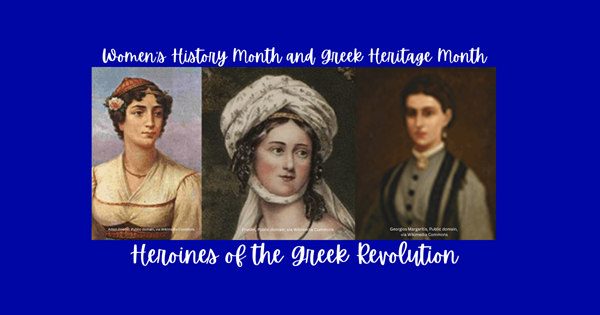
Heroines of the Greek War of Independence
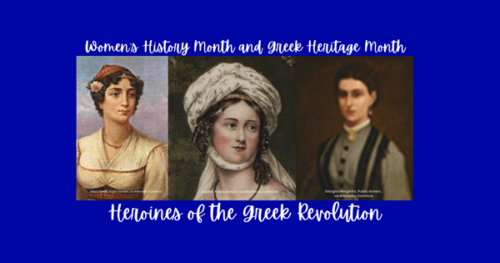
Did you know that women were vital to the fight for freedom? And I’m not talking about standing on the sidelines, cooking, or performing other traditional roles. Women were financiers. Leaders. Commanded ships. Raised funds. Drummed up support around the world. They even fought on the front lines. Not just Bouboulina. Not just Manto Mavrogenous. There are so many more!
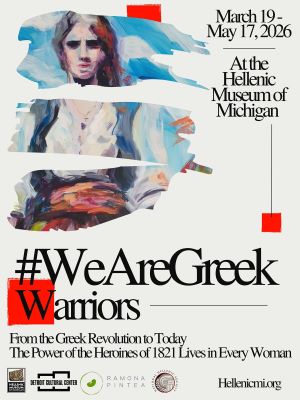
There’s a new exhibit coming to the Hellenic Museum of Michigan this month that celebrates their legacy, and brings them into today’s cultural conversation. It’s time for them to claim their rightful place in history! They are amazing role models for women and girls. We can garner inspiration and cull strength from them. I’m proud to be part of the team that’s bringing this exhibition to life. It’s worth a trip to Detroit! Lots of great programming around the event. Runs March 19-May 17, 2026.
In the meantime, here are some books to read to learn more about these amazing women and their impact. While most concentrate on Bouboulina, there’s much more to explore in both nonfiction and fiction. This Women’s History Month AND Greek Heritage Month, let’s celebrate the women.
I’m an Amazon affiliate. As an Amazon affiliate, I earn money from qualifying purchases. By clicking through the links, when you make a purchase, I’ll receive a small commission at no additional cost to you. It helps to support my writerly endeavors. Thank you!
NONFICTION
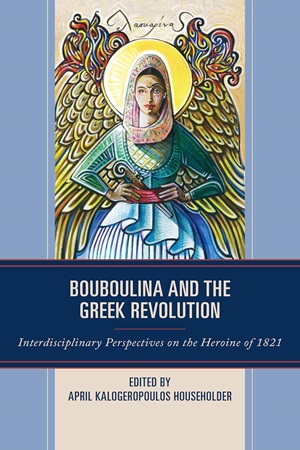
Bouboulina and the Greek Revolution: Interdisciplinary Perspectives on the Heroine of 1821 edited by April Kalogeropoulos Holder
(Lexington Books, 2023)
This volume, which includes chapters by several esteemed scholars, is the first to present an in-depth analysis of the life and times of Laskarina Bouboulina, the legendary heroine of the Greek Revolution and one of the most important figures in modern Greek history and the world. Most Greeks know of Bouboulina, who at age 50 commanded a fleet of ships from the island of Spetses and became the first female admiral in world naval history. But her success on the battlefield is only part of the story.
By considering her three-century impact on feminism, cultural production, and as a touchstone of diasporic Greek identity, the contributors also expand our understanding of her far-reaching and under-recognized contributions. This book opens a door to Bouboulina’s life and legacy. We also learn how her role was often underplayed and why. We get great insight into how she is depicted in art and popular cultural, how she’s viewed abroad, and more.
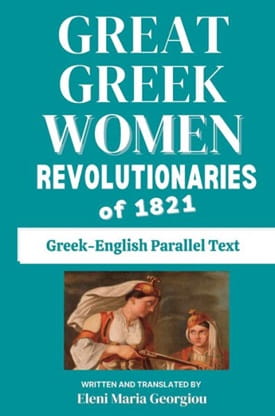
Great Greek Women Revolutionaries of 1821 by Eleni Maria Georgiou
(Lenacke Press, 2022)
This short work profiles four women warriors of the Greek War of Independence–two of which I hadn’t heard of before. The first section includes Greek-English parallel text, and then a section all in Greek, and another all in English. The book is intended for advanced learners of the Greek language who wish to improve their vocabulary, spelling and grammar skills. Likewise, native Greek speakers can use the book to improve their English language skills. The biographies are intriguing. And how cool to read the Greek translations! It’s a quick and informative, especially for language learners. Every Greek school kid should get a copy of this to augment their studies for Greek Independence Day.
Buy it at Barnes & Noble (not an affiliate link)
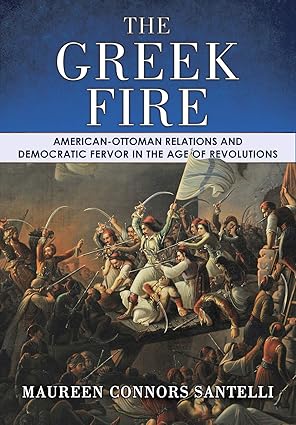
The Greek Fire: American-Ottoman Relations and Democratic Fervor in the Age of Revolutions by Maureen Connors Santelli
(Cornell University Press, 2020)
Did you know that American women raised funds, sent aid, and rallied support for the Greeks during the Greek War of Independence? Dr. Santelli explores the early global influence of the US through its fascination with the Greek Revolution of the 1820s and 1830s. The American philhellenic movement pushed U.S. interests into the eastern Mediterranean, shaping domestic conversations on freedom and reform. Believing Greece to be the birthplace of American democracy, Americans—both northerners and southerners—supported the Greek cause, with women-led philanthropic and missionary groups promoting humanitarianism, education reform, and evangelism. All while the US government remained neutral, prioritizing commercial ties with the Ottoman Empire over intervention.
The Greek Fire reassesses America’s role in the Greek Revolution, revealing how early foreign engagements shaped national identity and diplomacy. American women helped Greece! Santelli highlights how these debates helped define what it meant to be an emerging global power in the nineteenth century.
Buy it on Amazon (not an affiliate link)
My Greek Girls: Charismatic Heroines of the Greek World by Maria Socratous
(Independently published, 2025)
The author presents intimate portraits of her favorite “Greek Girls” – not just from the Revolution, but from empresses of Byzantium to stars of the silver screen, from tragic royals to beloved singers, from warrior heroines to influential feminists. Passionate love stories, tempestuous personal lives, controversial public personas, set against turbulent Greek history. None of these women had it easy. Some fought battles literally, in wars, others in public life. Some were imprisoned, some exiled, some slain, all loved or revered. My Greek Girls profiles the Empress Theodora, Bouboulina, Manto, Penelope Delta, Sophia Vembo, Aliki Vouyouglaki, Melina Mercouri, to mention but a few, who were icons of Greek culture.

TWICE IN ’21 by Angeliki Mastromichalaki – Pandelis Zouras; illustrated by Spyros Zacharopoulos
(En Plo, 2021)
This book provides “brief portraits” of those who spearheaded the Revolution of 1821. The authors selected 21 men and 21 women, of which “the selection of the persons was made after a long and very careful study of the sources that inspired us to record their stories”. The men are noted figures, however, little is known about the names of the 21 women featured here, and even less well known about their activities before the Revolution, during it and after it. These 21 women participated in the uprising and fought sometimes with the sword and sometimes in social battles. They were mothers, wives, lovers. Female role models whose mention removes the veils of oblivion from their essential participation in the struggle for the creation of modern Greece and places them equally alongside the male fighters. Created for kids, but there’s lots here for all ages to learn.
Can’t find it in the US. Still searching for a Greek site that will ship to the US.
Are you on my email list? Get my monthly newsletter and stay up to date on all my latest news, learn about recent blog posts, and more. And get in on great book giveaways! Click HERE to join. It’s FREE.
FICTION
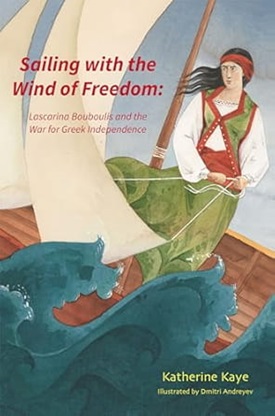
Sailing with the Wind of Freedom: Lascarina Bouboulis and the War for Greek Independence by Katherine Kaye
(Damianos Publishing, 2023)
In this novella, Katherine Kaye brings Bouboulina to life in a new way. While we don’t know extensive details of Bouboulina’s young life, the author imagines Bouboulina’s early years to bring this history to light. The intriguing storyline not only introduces the major figures in the Greek War of Independence (think Kolokotronis, Ypsilantis, etc., and even the Filiki Etairia) but does so in a captivating way. While this novella is intended for middle grade audiences, it’s suitable for all ages. It’s a great way to introduce this important part of Greek history. Bouboulina can serve as a role model, showing girls that they are strong and they can do extraordinary things.

Andronike: The Heroine Of The Greek Revolution by Stephanos Theodoros Xenos, Edwin A. Grosvenor
(Forgotten Books, 2018. Originally published by University Press in 1897)
Not about a real heroine per se, Andronike, inspired by true events, is a stirring historical romance novel written by Xenos and translated to English by Grosvenor, who was a historian and chair of the history department at Amherst College. It’s set during Greece’s 1821 uprising, where love and courage collide.
In a tale that blends romance with the birth of modern Greece, Andronike follows a young heroine through a world of danger, devotion, and daring. As a hidden story unfolds against the backdrop of monasteries, siege warfare, and political intrigue, readers glimpse the passions and trials that shaped a nation. The narrative weaves personal loyalty with national duty, inviting readers to walk the crowded streets of Missolonghi and shadowy corridors of power. Rich with period detail, the core story centers on courage, heartbreak, and the resilience of those who fought for a future they believed in.

The Winds of Liberty: A novel of Elizabeth Ypsilanti by Amalia Bouranta
(Independently published, 2025)
Elizabeth Ypsilanti was a Greek aristocrat known as the “First Lady” of the Filiki Etairia”, because she organized the preliminary sessions under the guise of literary meetings, which eventually led to the establishment of the Society. She is most likely its first female member. Born in Moldavia with roots in Epirus, she was the 2nd wife of Constantine Ypsilantis, the ruler of Moldavia. Together they had 7 children, three of which became members of the Society and protagonists of the Greek War of Independence: Alexandros, Dimitrios and Nikolaos. After her husband’s passing, she became one of the main sponsors of the Revolution. Her efforts left her penniless.
The novel opens in 1786 at the glittering salons of Petersburg, where a young woman’s fate intertwines with that of the captivating Constantine Ypsilantis, the son of Prince of Moldova, at a lavish mask ball. Their connection is instant and electric, but he is bound to another through an arranged marriage. Fueled by the winds of change sweeping through Europe and inspired by the calls for liberty, she envisions a different path for herself, one that leads her to the founders of the Filiki Etairia and ignites a daring plan that will shape the course of history: the Greek War of Independence. A tale of love, political intrigue, and the quest for freedom, set against the backdrop of a tumultuous era.
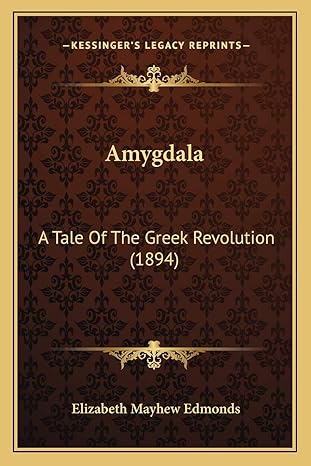
Amygdala: A Tale Of The Greek Revolution translated by Elizabeth Mayhew Edmonds, 1894)
(Kessinger Publishing, LLC, 2010; originally published in 1894)
This historical novel is set during the Greek War of Independence and follows the life of a young Greek girl named Amygdala. It explores themes of love, loyalty, and patriotism as Amygdala becomes involved in the struggle for Greek independence against the Ottoman Empire. Along the way, she falls in love with a Greek soldier and becomes a spy for the rebels, risking her life to help them gain an advantage in the war. The book provides a vivid portrayal of the Greek Revolution and the challenges faced by those who fought for their freedom. It also highlights the role of women in the war effort and their contributions to the cause of Greek independence.
Buy it on Amazon (not an affiliate link)
Heroines of the Greek War of Independence
That should get your started! There are many scholarly articles written about the heroines, and surely there are more books to learn more about women’s role in the Greek War of Independence. Happy Women’s History Month AND Greek Heritage Month!
Read more:
My Greek Books—February 2026 Reads
Ignite Your Warrior Spirit with #WeAreGreekWarriors at Hellenic Museum of Michigan (Greek City Times)
ΖΗΤΩ ΕΛΛΑΣ! Greek Independence Day: History, Celebration (WindyCity Greek archives)
Women’s History Month: Manto Mavrogenous (WindyCity Greek archives)